Abbot
Wolfgang Arrives
from Metten Abbey
Gives his Impressions of Saint John's History and
Spirit during Our
150th Anniversary Mass on June 24
The following is the text of Abbot Wolfgang's homily addressed to the Saint John's community and a crowd of about 800 visitors celebrating our anniversary. He is Abbot of Saint John's "Grandmother" Abbey in Bavaria.
Brothers and sisters in God!
Happy birthday for
your 150th anniversary. I really take delight in expressing the best
wishes and hopes of blessings of your grandmother in distant Europe.
But what do
150 years mean when we compare them to our own history which goes back
almost 1250 years in time. 40 years ago
on the occasion of the 1200th anniversary of our monastery one of my
brothers wrote in an article of the commemorative volume:
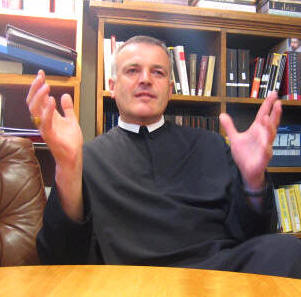
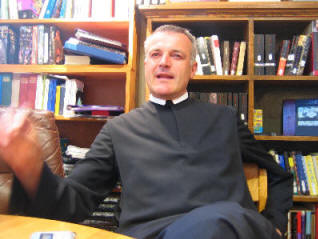
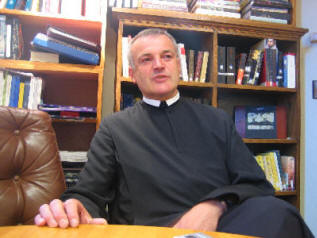
Abbot Wolfgang Hagl,
O.S.B., from
Metten Abbey in Bavaria, is impressed with American monks' pioneering
spirit,
confidence, and self-reliance.
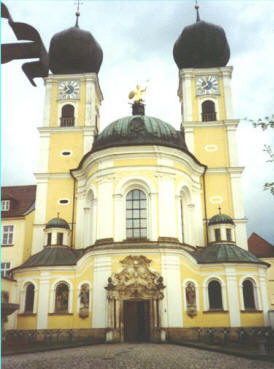
Metten Abbey's Church
“A monk must have already reached the tenth step in humility in order to avoid smiling in a disparaging manner at festivals celebrating their tenth anniversary, states that remember their twentieth year, and parties that celebrate their hundredth anniversary while his monastery is already twelve hundred years old. At such a high age you won’t cheer in a frenzied way but take it calmly; you will restore the chapel’s organ, answer some cheeky questions from journalists and as for the rest you will hope to get over the anniversary without a financial deficit but with sunny weather.”
My brother would certainly show much understanding as we celebrate today the 150th anniversary of this great and important Abbey St John, which could be considered to be a “granddaughter” in Minnesota of this old Bavarian abbey.
Celebrating a big birthday implies getting thoughtful, remembering the history and tradition which we stand for. And this one really is great. We are proud of it and it is this history which has encouraged us and has served as an incentive to continue the legacy of our fathers on the one hand and to face the challenges of our day and age on the other hand.
Each generation bases its efforts on the achievements of the preceding one. We have to work with the same enthusiasm. We have always been confronted with the same problem. A Benedictine monastery is directly placed into the world. Its asceticism doesn’t despise the world, is not escapist; it appreciates the good elements that any period of human history brings along. The result is that marvelous synthesis of inertia and progress and which would imply that any generation is different. It’s up to us today to continue the dedication to God and the work which for 150 years has been assigned to the brothers here at this place.
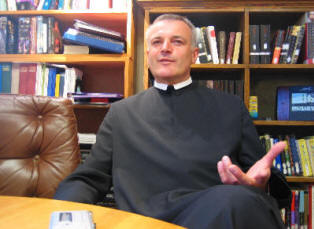
"It’s up to us
today to continue
the dedication to God and the work
which for 150 years has been assigned to
the brothers here at this place."
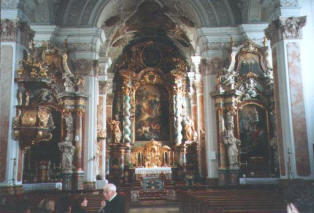
Interior of the Metten Abbey Church
It wasn’t anybody but Bonifaz Wimmer, the man who had conveyed the old Benedictine Order to the New World, the founder of the American-Cassinese Benedictine Congregation, the first Archabbot of St Vincent, who 150 years ago founded the great abbey of St John’s in Minnesota –- beginning with five monks who set out along the Ohio River from Saint Vincent’s and made their way up the Missisippi to St. Cloud, Minnesota in April 1856. This was Bonifaz Wimmer, a Bavarian Benedictine monk from the old abbey of Metten, the Bavarian “Bonifatius,” as he was not reluctant to be called.
Exactly there of all places in Bavaria, which formerly was so devoted to Catholicism, anti-clerics had hit most efficiently: in 1803 – some years before Bonifaz Wimmer was born, all monasteries were closed by the state and the monks were driven away. Monastic life had become part of a fairy tale related to the past.
The situation probably was to some extent similar to the present. In the eastern part of Germany – 16 years after reunification – students at Berlin University recently asked their professor of history: “What was it all like in those days when Church was still alive?”
Bonifaz Wimmer entered into the convent of Metten, which had been refounded two years before. Even as a student he was fascinated by the religious order of St Benedict. What he especially felt attracted by were the achievements of this monastic order when it comes to the Christianization of the Occident as well as to its double stability: prayer in God and economic independence rooted in the landscape and in the population.
The beginning of his monastic life is marked by a short year, which was to bring about some controversy for Father Bonifaz and which consequently is rather revealing for the analysis of his character. It was the time of the so-called “Babylonian Imprisonment” in the abbey of St Stephen in Augsburg. Father Bonifaz together with several other monks from Metten was transferred to Augsburg in order to teach at the local school there. There were considerable tensions with the local brothers who felt dedicated to a completely different lifestyle than the monks from Metten. Father Bonifaz became the spokesman of the resistance group from Metten. He refused the transfer of the Stabilitas Loci to St Stephen. That led to some violent controversy with the bishop of Augsburg. After an impulsive argument Father Bonifaz left the bishop’s audience room claiming that he had received confirmation for a second time. Those who are familiar with the old rite of confirmation know what Father Bonifaz has experienced.
However, the bishop fell seriously ill and could no longer plead the cause of St Stephen. Father Bonifaz considered that to be the result of divine providence; anyway he wrote to his “home-bishop” in Regensburg: “Our Most Reverend Bishop of Augsburg isn’t expected to survive the week to come. I think he was prayed towards death, because if he hadn’t been ill these last three months and consequently forced to be inactive, we couldn’t have achieved anything.”
"In
1803, some years before Bonifaz Wimmer
was born, all monasteries were closed
by the state and the monks were driven
away. Monastic life had become part of a
fairy tale related to the past."
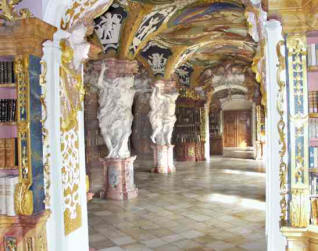
Metten Abbey has one of the most beautiful baroque libraries in all of Europe
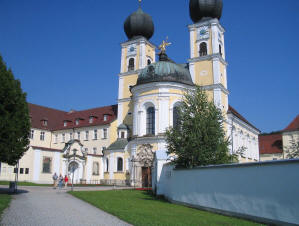
Entrance to Metten Abbey and School
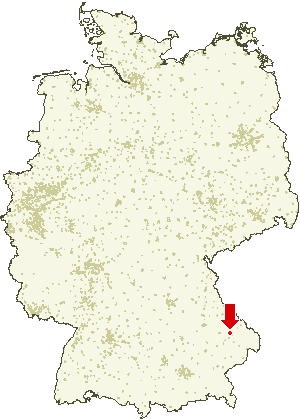
Metten Abbey is
in Bavaria,
close to the Czech border
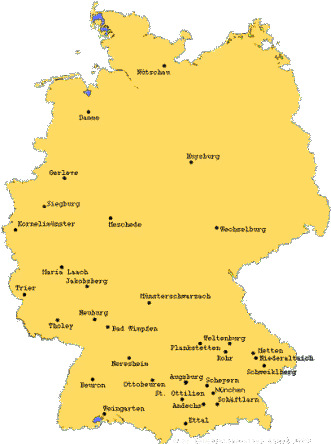
On this map you can see all 32 Benedictine monasteries of men in Germany
http://www.benediktiner.de/d-maenner/index.htm
The Bavarians are generally considered to be stubborn; the people in Bonifaz Wimmer’s home county sometimes seem to extremely pigheaded and might be compared in this respect to the inhabitants of New England in the United States. But if God has equipped a man with this talent of perseverance he must certainly have had good reasons. In the life of a monk this might of course lead to problems with obedience. Such problems Bonifaz Wimmer often had to face – and his superiors were toughly confronted with his commitment. Yet when it came to dealing with ecclesiastical and national authorities his toughness turned out to be a real blessing. But at least he was – similar to the patron saint John the Baptist – not like reed swaying in the wind but a strong oak-tree trunk you can rub against but also cling to.
Bonifaz Wimmer became the founding father of the great American-Cassinese Benedictine Congregation.
After St Vincent had been promoted abbey he started a foundation of priories. Six dioceses had presented their requests. As had learned much from his contacts with Bishop O’Connor, the monks of St Vincent decided to settle down there only where from the beginning the respective landownership was transferred to them and where the bishop refrained from any unjustified interference. In due course St John’s in Collegeville/Minnesota and St Benedict’s in Atchison were founded in the West as well as Newark as centre in the East. Further dependencies followed, whose promotion to abbeys Abbot Bonifaz was partly allowed to live to see.
In the eve of his life Bonifaz Wimmer could look back to a performance which was hardly granted to any other Benedictine monk in the 19th century. Nevertheless the age of retirement was not easy for this learned character. Pains of old age paralyzed his capacity for work which up to that point in time had been so impressive. He became lonely as the gap between him and the younger generation was widening. He felt like “Adam (in Paradise) before the creation of Eve, like an old tree surrounded by young plants”. These were his own words.
Which conclusions can we draw from such a life? Monastic according to the principles of Cluny, Solesmes or Beuron was it definitely not; Bonifaz Wimmer continued, however, some older Benedictine tradition, some of the early Middle Ages, when Anglo-Saxon monks flooded into Central Europe in order to teach Christianity and to stabilize it by founding spiritual centers. Bonifaz Wimmer also felt dedicated to this things in America 1000 years later, of course applying more modern means; but it is the very same aim which the congregation founded by him still is committed to.
What we monks of today have in common with Bonifaz Wimmer is and will always be our care for the well-being of humankind. It is the ultimate reason for all our efforts. In this respect now and then the celebration of the Opus Dei has stood in the centre of monastic life.
Thus the word of admonishment of Saint Bonifatius from the year 742 is still valid for us today: “We neither want to be silent dogs, nor mercenaries who try to escape from the wolf, but caring shepherds, who keep watch over the flock of Christ, who tell the will of God to the young and to the old alike, to the rich and to the poor, to all social classes and to any generation, whether it suits or doesn’t suit us.”
Dear confreres of St. John’s Abbey, I wish you success also in mastering the future, by connecting the reliable monastic values with the traditional American virtues, which are so fascinating for us Europeans. For you a problem is not a catastrophe but a challenge, you don’t know any social envy but you are pleased about those who are successful. Optimism – or better: faithful realism, the spirit of the pioneers, confidence and self-reliance belong to these American virtues. All these virtues are the envy of us Europeans and they make you so successful.
The paintings of our founder, abbot Utto, in Metten show an axe hanging with a sunray. This is a good picture because it wants to say that great things will happen where the sunray of divine grace is combined with human diligence, commitment and devotion. For 150 years it was like this in St. John’s Abbey and I hope that it will stay like this in the future.
God bless St. John’s Abbey and may the Lord guide your Abbey into a good future!
"Father Bonifaz could move the universe if it seemed necessary..."

Metten Abbey,
founding Abbey of
Saint Vincent's Abbey in Pennsylvania
and Saint John's Abbey in Minnesota,
runs a Prep School and College
for boys 10-20 years old.