office: 363-5354
email: hjakubowski@csbsju.edu
home page: http://employees.csbsju.edu/hjakubowski
TEXT: Chemistry, 4rd Edition. McMurray and Fay (2004)
CLASS: 11:20-12:30 AM, Days 2-4-6; Ardolf Science Center, 142
LAB: Day 1, 1:00-5:00 P.M; Ardolf Science Center 202/204
OFFICE: Ardolf Science Center, 245; CSB
OFFICE HOURS: Days 2, 3 and 6, 2:30 p.m. - 3:30 p.m. and by appointment
SCHEDULE
Tentative Daily Schedule and Assignments
NOTES FOR THE FIRST LAB
You need to have goggles on the first day of lab. Some of you may already have them. Bring them with you to lab, but they must be approved before you can use them. If you don't have goggles, you can purchase them at the bookstore. The cheaper version (around $10) fog up. The $18 version is much better.
Short and sandals are not allowed in the lab. You will not be allowed in lab if you are wearing them.
Purchase a lab notebook (around $11) from the bookstore before you come to the first lab.
COURSE OBJECTIVES
EVALUATION PROCEDURE
Four exams are scheduled for this class (three regular exams and one final exam). I will replace your lowest regular exam score with the final exam score if the final exam score is higher than your lowest regular exam score. In that case, your final will count twice, once as a regular exam and once as the final. This policy is designed to help you if you had a bad day on one exam and to give you motivation to study hard for the final exam.
EXAM SCHEDULE: Tentative
EXAMS
I will give three period-long exams during the semester, and one final exam. The three period exams may consist of any combination of multiple choice questions, short answer questions, and/or problems. The final exams is an American Chemical Society multiple choice exam given to all students taking General Chemistry I.
LABORATORY ATTENDANCE AND COURSE GRADE POLICY
Failure to complete a lab or labs without a valid reason will have the following consequences on FINAL COURSE GRADES:
Completion of a lab or lab equivalent is defined as both attendance at the lab and completion of the requisite written report.
NOTE: An unexcused lab will result in an F (0 points) grade for that lab. This grade will be averaged in with the student's other lab grades for the semester when calculating the final laboratory grade or T score. The final laboratory grade will contribute 20% toward the final course grade. It is this final course grade which will then be lowered by unexcused absences. Students having a valid excuse may reschedule the lab, if possible, only if they notify the LABORATORY COORDINATOR before the scheduled lab.
PARTICIPATION
Your final grade can be influenced by the extent and quality of your participation. Average participation will neither boost or detract from your grade. Lack of participation might be reflected by a lowering of your final grade a half-step (i.e. from AB to B) if your final grade is near the borderline of those grades. Likewise, significant participation might be reflected by a raising of your final grade by a half-step (from AB to B). Participation suggests interest and effort. It is not limited to just asking/answering questions in class. It includes things like:
MISCELLANEOUS NOTES:
Attendance at class is expected. If you miss a class, it is your responsibility to find out what you missed and to be prepared for the next class. If you miss to many classes, you may be asked to withdraw from the class.
I will drop one quiz grade. If you miss a quiz, you will get a grade of 0 for that quiz. Presumably, you will wish to drop that quiz grade which implies that all others will count toward your grade. No makeup exams will be given unless for a certifiable emergency. Any makeup exam will be more difficult than the original and consist of oral and written questions.
15% of the grade derives from quizzes, homework, and group activities, which we will do in most classes. Because of this, ATTENDANCE IS MANDATORY! The group work will vary from informal, ungraded exercises to formal, graded problems. Homework will be assigned for most chapters. All questions should be completed. I encourage you to work in groups. Only random questions from the homework assignments will be graded and if I ask them to be submitted, you must do so prior to the start of class the day they are due. No late homework assignments will be accepted for grades. Quizzes will usually be announced during the previous class. Some grades will be group grades. The final exam will emphasize the material presented after the last exam, but will also be cumulative.
INDIVIDUAL VS GROUP ASSIGNMENTS
Individual: All students are expected to provide the results (answers, reports, etc) by doing their own individual work, written in their own words. In some cases, clearly indicated by my, students may consult with other classmates, TAs, tutors or the instructor in attempting to understand the material involved. However, even in these cases, students must submit their own results. Clearly, there are some individual assignments where consulting would not be allowed (quizzes, exams, etc.)
Group: All members of the group are expected to meet and discuss all parts of the assignment, even if they initially divide up the assignments into individual parts. All members must understand the results (answers, reports, etc.) that are being submitted and agree to a a single set of results that will be submitted for grading. All group members receive the same grade for the assignment.
EXPECTATIONS
Most of you probably had chemistry in high school. You may have had an introductory course, or taken AP Chemistry. You probably took it in your Junior year. You bring in differing levels of understanding of chemistry � both factual and conceptual, both of which are probably rusty. In high school, chemistry may have been one of your most difficult classes. Now, you will take chemistry again, only this time in a completely different context. For many of you in your first year at CSB/SJU, you will be taking chemistry along with three to four other demanding classes. In addition, the pace we will take will be faster than in high school. You will have to learn and use new study habits for the rigors of the academic expectations at CSB/SJU. All of this is happening at a new time in your lives when you�re trying to make new friends and adjust to a brand new environment. There will be many competing demands for your time. How are you going to deal with all of these demands? It's up to you. I can provide the learning environment, but you will have to do the learning. High grades in college don't come as easily as they do in high school. What can you do to do well?
Here is what I expect from students:
Here is what you can expect from me:
STUDYING CHEMISTRY
Chemistry is a difficult field. One study showed that there are as many new words in a first year general chemistry class as in a first year foreign language class. The words have precise, but often difficult meanings. (examples: thermodynamics, enthalpy, free energy). Critical thinking skills are required. In addition, there is much content to learn. It's not a course that centers around discussion or your opinion, but your ability to problem solve. To be successful in the class, you will need to study regularly and diligently. Click the link below to find out some proven ways to study successfully that were compiled by Ronald Ragsdale, University of Utah..
Learning is a complex endeavor. It can be fun and easy and we would like it to be that way. More often it is challenging, difficult, and associated with failure (temporary, we hope). Our goal as life-long learners is to try new strategies when we encounter difficulties and failures on the path to understanding, and transform our fears into courage and frustrations into patience. True and deep learning comes when we overcome failures and our fears that prevent us from doing what we need to do. We move
from fearing a new challenge to having courage to face the challenge,
from frustration when our attempts fall short to patience for ourselves and the hard work we know is required
from failure to self confidence as we overcome failures.
It is easy to blame yourself or me if you have difficulty with this class. Both are unproductive. You need to adopt a new strategy, as described below. These strategies work for any situation you find difficult, not just General Chemistry.
WHAT DOES IT TAKE TO GET AN A?
COMPUTER USE - the ONLINE STUDY GUIDE (OLSG)
I will make extensive use of email and will post some notes and graphics on a web site for the course called the On Line Study Guide (OLSG). The main web page is divided into links for each chapter in the book.
These are the kinds of links you will see under the chapter sections:
Web links to handouts I have given in class (example) or to useful, external sites (example). The links are in color.
Java Applets that provide interactive demonstrations of chemical and physical principles (example)
Chime Interactive Molecular Graphics (example) This requires a free plug-in called Chime (2.6 SP3) for your internet browser (use Internet Explorer 5.5 or 6.0) which you can download free for your home computer from MDL Information Systems. If you view these files from any of the CSB.SJU PC computer labs, the Chime software is already on the system so you can see the molecular files without downloading the program.
USE OF
OWL
OWL (Online Web-based Learning) is a program for online, graded chapter problems.
Directions for first time Student OWL Registration
Go to http://owl.thomsonlearning.com .
Select the link for the type of course you use. (General)
Find your textbook (Chemistry & Chemical Reactivity, 6th Edition; Kotz, Treichel, & Weaver)�Note�this is not the same as the textbook that you purchased for the course.
Find your institution (College of St. Benedict)�Note�select this even if you are a Johnnie.
Find your department (Chemistry Department)
Select "Student Registration" by clicking the red arrow
Select "Section #" by clicking the red arrow (Make sure you pick your proper section and instructor - Henry Jakubowski, CH123-07A)
Follow instructions for completing registration form
student #--use your student ID # (begins with 900)
login and password�you can use anything allowed by OWL, but I suggest using your network login ID and password so it will be easy to remember.
Use the OWL passcode provided by your instructor in the Access Code space.
Eventually you will be prompted to change your password to something that you will remember.
AFTER registering, directions to login:
1. Go to http://owl.thomsonlearning.com
2. Select the link for the type of course you use.
3. Find your textbook
4. Find your institution
5. Find your department
6. Select "User Login Page" by clicking the red arrow.
7. BOOKMARK this OWL User Login page in your browser and visit it whenever you want to login to your OWL course.
8. Enter your Login and Password you entered when you registered for OWL and press the Log In button. If ever your forget your login and password, use the "Email my login/password" button.
IMPORTANT NOTE: The OWL system requires particular/current versions of plugins to make all parts of the animations and simulations work. Proper versions are available on computers in CSB/SJU computer labs. Some or all assignments may not work properly on your personal computer. You may be able to download free plugins for your personal computer when prompted within OWL.
Here are a series of links to get you start in Owl if the above instruction don't work.
NEW 9/7/06: Posting Answer Keys
I will post answer keys through a program called
Moodle

To get to the keys, click on the link to Moodle . When there you can “enroll “ in the CHEM 123: General Chemistry, 06 A (note that this is the wrong section number). Follow prompts to personalize your Moodle Homepage and change your password. Select the answer key you would like to see. I might also post an article there for you to read.
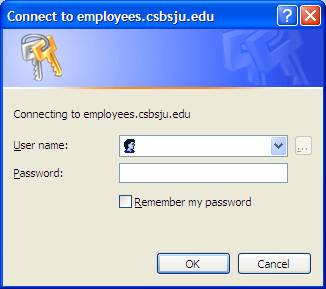
Note: some of my own assignments (not those on OWL) might prompt you for a username, password, and/or domain name. The following windows might appear:
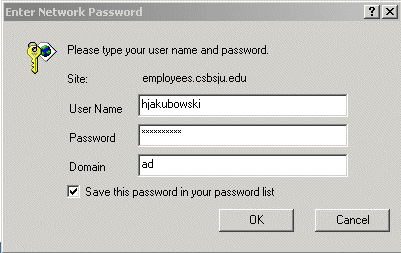
For usrname type in your own username
For the password, type in your network password
For domain, type in ad.
Some of you might get a different window such as displayed below
There is no place for the domain name. In that case, include the domain name, ad, as shown below (for the hypothetical user jngramke):
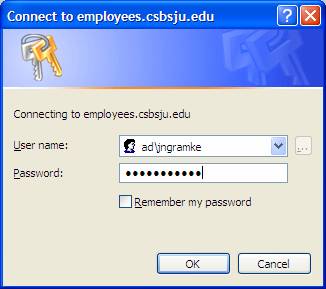
PLEASE NOTE: IN THIS CASE YOU MUST USE THE BACKSLASH (\) NOT THE FORWARD SLASH (/)!
II will use some of the Chapter review multiple choice questions from Prentice Hall on exams which have multiple choice questions. I my also assign additional homework based on the web material.
CHANGES IN THE SYLLABUS
I have the right to amend this syllabus during class in ways which I feel will facilitate student learning.
Last Update: 11/20/2006