 |
Plants & Human Affairs (BIOL106) - Stephen G. Saupe, Ph.D.; Biology Department, College of St. Benedict/St. John's University, Collegeville, MN 56321; ssaupe@csbsju.edu; http://www.employees.csbsju.edu/ssaupe |
|
|
Plants & Human Affairs (BIOL106) - Stephen G. Saupe, Ph.D.; Biology Department, College of St. Benedict/St. John's University, Collegeville, MN 56321; ssaupe@csbsju.edu; http://www.employees.csbsju.edu/ssaupe |
General Information
 |
|
Instructor:
Dr. Stephen G. Saupe
Office:
335
Science Bldg; 363-2782; ssaupe@csbsju.edu
Office Hours: schedule posted on my web site
Web Site: http://www.employees.csbsju.edu/ssaupe/
Course Web Site: http://www.employees.csbsju.edu/ssaupe/biol106/106_home.htm
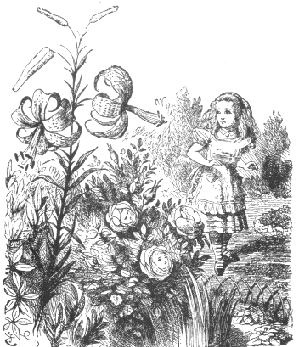
Course Description: This course will examine the way in which plants have been utilized by humans and the economic, historical and social impact of their use on our lives. Or in other words, from the perspective of the Tiger � Lily, our explorations will make us "worth talking to."
Ultimately, this course will focus on the "practical" side of botany. The course is divided in four major units: (1) Science - during this unit we will focus on the philosophy and nature of science, experimental design, and how to recognize pseudoscientific ideas; (2) Evolution - this is the major integrating theme in all of biology and arguably the single most important concept in the biological sciences. During this unit we will look at the history of evolutionary ideas, natural selection, and recent threats to evolutionary ideas; (3) Horticultural techniques - in this unit we will study basic botanical principles specifically how they apply to your garden; and (4) Economic Plants - plants that are used by people. In addition throughout the course we will discuss plants that have played an important role in our holidays.
Texts: (required, available in the SJU Bookstore)
Goals: Upon completion of this course you should be able to:
Audience: This course is intended for non-science majors and it fulfills the requirements for a Global Awareness flag.
Attendance: I do not directly penalize you for absences from lecture. However, I will keep track of your attendance by passing around a sign-up sheet. If you come in late try to remember to sign the sheet before leaving class (to thank you for signing the attendance sheet, you will receive a valuable botanical sticker). This information will be consulted only if you are on a grade borderline. Whether you are absent or not, you are still responsible for completing assignments (i.e., turning in any that are due and getting the assignment for the next class). In general, you will not be able to make up anything missed in lecture. You must attend every scheduled lab - No exceptions!
Class Time/Place: The lecture section meets Days 2-4-6 from 11:20 - 12:30 a.m. in PENGL 325, SJU. The laboratory meets 1:00 - 3:50 pm on Day 6 in PENGL 342. Plan on being in lab the entire scheduled period! Some lab work may be conducted outside of class.
Class Format: Class material will be presented via lectures, laboratories, and discussions. Laboratory exercises are designed to parallel and augment lecture material. Discussions will focus on a particular topic of interest. Various demonstrations, in-class exercises, and AV materials are also anticipated. I try to minimize lecturing because I believe that science is best learned by "doing." Cooperative learning will also be an important part of our course.
The general format of each day will be similar so that we can establish a routine or ritual for our studies. Our format is designed to be fun and to get you moving, talking, and thinking in class right away.
"Fine and dandy! Why shouldn't I be?"
"I am super good, and getting better!"
"I am fantastic, and improving by the second!"
"I am terrific; you better believe it!" (while saying this thrust your finger towards the instructor)
Or, other greeting selected by the class leader
Review the previous class material (definitions, summary, quizzes, etc.)
Introduce new material (lecture, dialogs, videos, slides, etc.)
Practice & drill new material (exercises, quizzes, etc.)
Cool Down - review class activities
End of Class - please do not pack up to leave until we show our mutual respect for one another. I will close by saying, "Thanks - that ends another incredible day of biology." The class responds by saying, "Ditto, dude!" Or, the class leader selects a different closing.
Classroom Etiquette: The following is a list of suggestions to make our classroom experience as enjoyable and productive as possible for all of us:
Email: I typically check and respond to email first thing in the morning (between 8 & 9:00 am) and before I leave in the evening (usually about 5:30 pm). If you send an email after about 4:30 pm I will not see or respond to it until the following day because I do not check email after leaving my office. Please plan accordingly.
Evaluation
: Grades will be assigned on the basis of your performance on:
Deciduous Trees - Pre-Lab & Quiz
Leaves & Climate - Pre & Post Lab assignments
Osage Orange Experiment - Pre-Lab & lab report
Brine Shrimp Experiment - Post-Labs #1 & #2
Greenhouse growth
RCBr Pod Size Lab
RCBr Life Cycle Lab - Journal & pods
Surface/Volume Ratios - Pre & Post Lab assignments
Forensic botany
Plant care brochure
Pseudoscience presentation
Your course grades will be assigned based upon the percentage of total points accumulated according to the following scale: 100 - 91% = A; 90 - 87% = AB; 86 - 81% = B; 80 - 77% = BC; 76 - 71% = C; 70 - 67% = CD; 66 - 60% = D; below 59% = F.
Good achievement on exams will be recognized by stars on your exams (gold = top score; silver = 2nd highest, red = 3rd, green = 4th, blue = 5th).
To determine your approximate grade at any time during the semester, simply divide the total number of points you have accumulated by the total possible (this information will always be provided). In addition, I will periodically post grades, anonymously, on the web (if you prefer your grade not be posted by an anonymous manner, please let me know). Check this report for accuracy and to provide an indication of your standing. I recommend that you keep for your records all of your graded work.
Never hesitate to come and talk to me about your grade, or any aspect of the course, at any time during the semester!
S/U grading can be requested at any time during the regular semester. You must submit your request in writing on a separate sheet of paper (not on a test or other assignment). Note: "S" is awarded for a letter grade of "C" and above.
Bonus Work: You will have the opportunity to earn bonus points by attending lectures, analyzing journal articles, participating in formal nature walks, or even reporting on science-related television programs. If it is "scientific" and can be reasonably considered to pertain to our course you can earn bonus points for participating in the activity. Obtain a "Bio-Bonus Card" and turn it in to me following the activity. Cards are due no later than Study Day. As a general guide - lectures are worth five bonus points, journal summaries and book reviews are worth 3 bonus points, and summaries of TV programs are worth 1 points. For other activities, we will assign an appropriate number of points. If in question, ask. As a rule of thumb, more than 20 bonus points will have little impact on your final grade.
File: You will have a personal file folder in a file box in SC 343 (Botany lab). You may use this file to store papers/notes/etc. In addition, I will place in this file any assignments not returned to you personally. Also, extra copies (if any!) of handouts will be available here. When in doubt or need, check here.
Flags: This course has a Global Reasoning flag. This requirement will be fulfilled by lab reports, homework assignments, and in-class writings.
Honor Code: I run this class on the Honor Code system; in other words, I trust you to do your own work at all times. If you violate my trust, the consequences will be severe. If you have even the slightest doubt that an activity violates the Honor Code - don't do it. In addition to the obvious violations (i.e., cheating on exams, plagiarizing), turning in data from someone else without giving them credit, is a violation of the Honor Code. In general, no photocopies, other than group raw data, will be accepted from another source.
Laboratory: Since "the lab is the place where science gets done," it's not surprising that this course has a lab component and it contributes to a major portion of your grade. The major objectives of lab in this class are to: (1) provide a introduction to the scientific process, and (2) give you an opportunity to work hands-on with a variety of plants and their products.
Late Assignments: I reserve the right to accept or refuse late assignments.
Pride: I believe that the appearance of an assignment is a reflection of the quality of the work and the degree of respect it deserves. Thus, for your benefit (and my eyesight) I require that all written assignments (with some obvious exceptions - when in doubt, please ask). Assignments not typed will be penalized 50% of the total possible points. Also, assignments completed on paper torn out of a spiral notebook will be penalized 20% of the total possible points. If you like to use spiral notebooks that's fine - simply remove the frayed edges before turning in your work. Please remove perforated strips from computer paper and separate pages. Assignments should be stapled if more than one page.
Questions: Always welcome!!
Required Materials: In general, you will be supplied with everything you need. Your student account will be charged a lab fee, as specified in the Course Booklet, for expendable supplies.
Teaching Philosophy: I think that learning should be enjoyable. Hopefully we will laugh together and have fun. Stamps, stars and stickers will adorn some of your graded assignments. "Biological" music will greet you when you arrive in class. This is all done in good fun, to make our learning environment more pleasant. Yet, we will always be respectful of one another. Some students in the past have commented that they think some of what we'll do is "childish." I hope so because I want to generate some of the fun and enthusiasm that children have for learning. But remember, even though we may be silly and have fun, I am still very serious about the goals of our course. I have provided a more complete statement of my teaching philosophy if interested.
Three Ring Notebook: I recommend the use of a three-ring spiral bound notebook. All course materials will be punched with three holes for your convenience. It has been my experience that students with well-organized notebooks perform better than those with messy, unorganized ones.
Visitors: Visitors to our classroom are welcome. Please introduce them to me. And, they should plan to participate (as best they can) in class activities
Last updated: 08/28/2008 � Copyright by SG Saupe