 |
Plant Physiology (Biology 327) - Dr. Stephen G. Saupe; College of St. Benedict/ St. John's University; Biology Department; Collegeville, MN 56321; (320) 363 - 2782; (320) 363 - 3202, fax; ssaupe@csbsju.edu |
|
Plant Physiology (Biology 327) - Dr. Stephen G. Saupe; College of St. Benedict/ St. John's University; Biology Department; Collegeville, MN 56321; (320) 363 - 2782; (320) 363 - 3202, fax; ssaupe@csbsju.edu |
Lecture Syllabus
| Cycle | Date |
Topics & Key Questions (For most topics, online notes and quizzes are available) |
|
I
|
Jan 13 (T) | Introduction to Plant Physiology (What is a plant? What is plant physiology? Why should we study plant physiology?) (on line notes; study guide; quiz - Moodle; Botany Without Borders - K Niklas/BSA film) |
| 15 (Th) | The plant way of life (How has the plant lifestyle been evolutionarily-shaped by their phylogeny?) (on line notes; foraging case study; study guide; Concepts Maps; quiz; essay questions) | |
| 19 (M) | Are plants smarter than you think? (Well?) (Readings in Moodle) | |
| II | 21 (W) | Seed germination (How do seeds germinate?) (online notes; study guide) |
| 24 (F) | Plant cells: structure & function (How do plant cells function?) (on line notes, study guide) | |
| 27 (T) | Plastids, vacuoles & cell walls (Why do plant cells have plastids, vacuoles and cell walls? What is the function/structure of these special structures?) | |
| III | 29 (Th) | Cell wall & cell growth (How can walls be rigid and strong, yet still permit growth?) (PowerPoint in Moodle, online notes; quiz; Acid growth exercise) |
| Feb2 (M) | Water relations - diffusion, osmosis, water potential (What determines the direction and rate of water movement in plants?) (online notes; quiz - water properties; quiz- water potential) | |
| 4 (W) | EXAM #1: Intro to cells | |
| IV | 6 (F) | Water balance - soil water and water uptake; Water distribution in containers (How do plants obtain water from the soil?) (online notes; quiz - water/soil; Spuds McSaupe Plays with Sponges) |
| 10 (T) | Water transport (How is water transported from the roots to the leaves?) (online notes; quiz-water transport; Spuds McSaupe & Capillary Tubes) | |
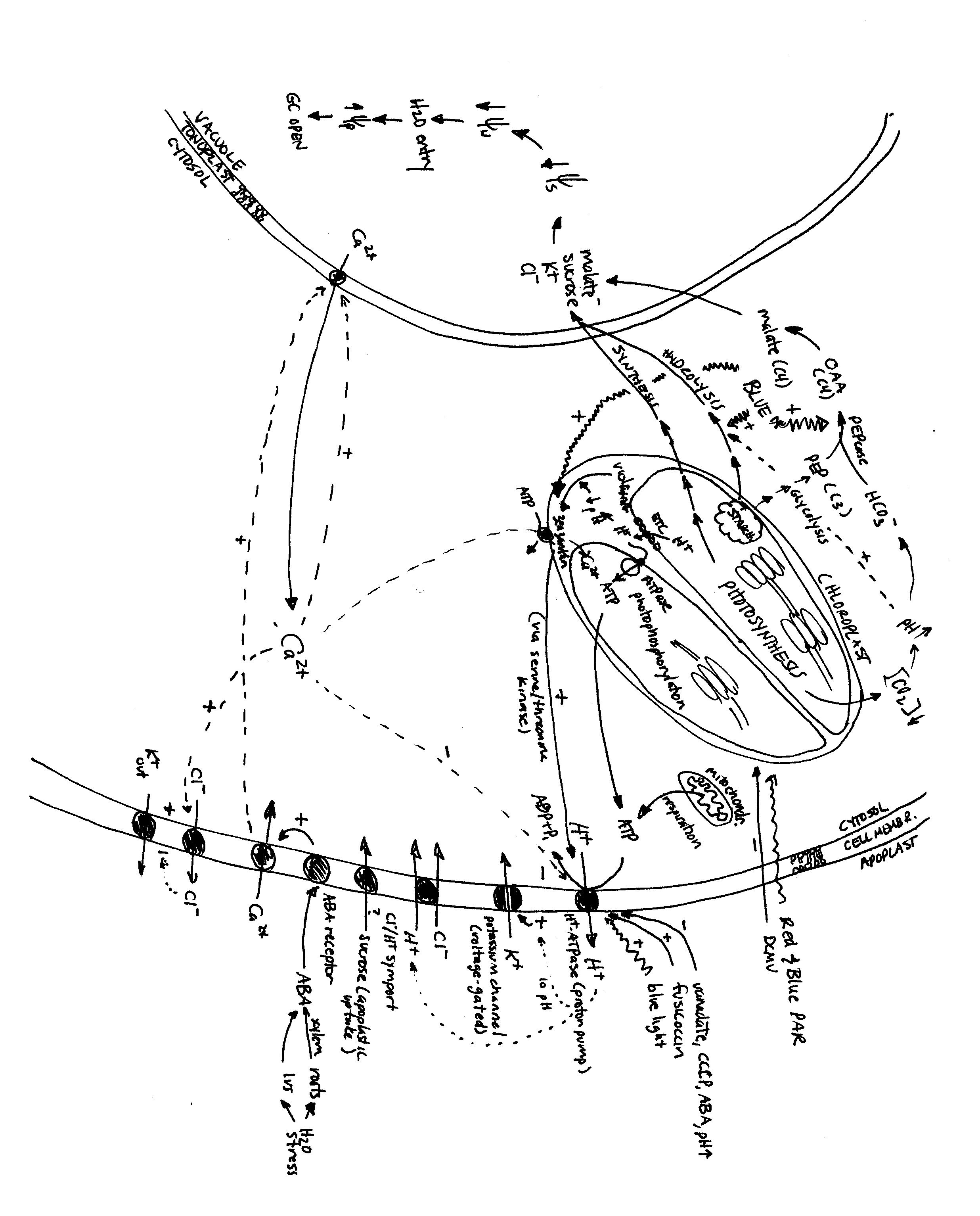
| 12 (Th) | Gas exchange and stomatal mechanics (How do plants solve the transpiration / photosynthesis paradox?) (online notes; quiz-gas exchange; GC mechanics diagram - jpg file, right click to save) | |
| V | 16 (M) | Phloem transport (How do plants transport nutrients from the site of production to the site of need?) (on line notes; phloem case studies; quiz-phloem) |
| 18 (W) | Mineral nutrition (What minerals are required for plant growth & development?); | |
| 20 (F) | Nitrogen metabolism & solute transport; nitrogen fertilizers (How do plants obtain and utilize nitrogen?) | |
| VI | 24 (T) | Autrotrophic metabolism - pigments & plastids (Why are plants green?) (online notes; quiz #1) |
| 26 (Th) | EXAM #2: Water - nitrogen | |
| 27-8 | Spring Break | |
| Mar 9 (M) | Autotrophic metabolism - light reactions (How do plants capture light?) | |
| VII | 11 (W) | Autotrophic metabolism - carbon metabolism (How do plants use carbon dioxide to make carbohydrates?) (online notes; quiz #2) |
| 13 (F) | Autotrophic metabolism - ecological considerations (How have plants adapted photosynthetically to hot, dry, sunny conditions?) | |
| 17 (T) | Heterotrophic metabolism (How do plants make ATP?) | |
| VIII | ||
| 19 (Th) | Growth & Development, Hormones (How do plants grow and develop, especially considering the restrictions placed on them by cell walls?) (online notes; case study) | |
| 23 (M) | Auxins (What do auxins do?) (PowerPoint in Moodle) | |
| 25(W) | Gibberellins (What do gibberellins do?) (PowerPoint in Moodle) | |
| IX | 27 (F) | Cytokinins (What do cytokinins do?) (PowerPoint in Moodle) |
| 31(T) | Ethylene (What does ethylene do?) (PowerPoint in Moodle) | |
| Apr 2 (Th) | Abscisic acid & brassinosteroids & other hormones (What do these hormones do?) (PowerPoints in Moodle) | |
| X |
6 (M) |
Phytochrome (How do plants monitor changes in day length and light quality?) (online notes) |
| 8 (W) | EXAM #3: Heterotrophic - other hormones | |
| 9-13 | Easter Recess | |
| 15 (W) | Positioning Responses - gravitropism (Why do plants bend when placed on their side?) (online notes) | |
| XI | 17 (F) | Phototropism and other positioning responses (Why do plants bend toward the light?) |
| 21 (T) | Flowering (How do plants control the timing of flowering?) (online notes) | |
| 22 (W) | Scholarship Day - public premiere of seed germinaion movies | |
| 24 (F) | More flowering | |
| XII | 28 (T) | Fruit development & embryogenesis (How do fruits develop?) |
| 30 (Th) | Senescence & dormancy (Why do plants leaves turn colors in the autumn and then fall off?) | |
| May 4 (M) | Spring Wildflowers; Course overview & summary (What unique physiological adaptations have spring flowering plants evolved?) (online notes; essay in Moodle) | |
| 5 (T) | Study Day | |
| 7 (Th) | Final Exam: Phytochrome to wildflowers; 8-10:00 AM |
Tentative Lab Syllabus (back to Lecture syllabus)
| Cycle | Lab Topic (lab materials available in Moodle) | Assignment Due |
| 1 | Creating Time Lapse Videos: Awn movement in Stipa; Image analysis using ImageJ |
Signed
Safety Contract Complete the pre-lab assignment |
| 2 | Video documentation of seed germination and early seedling growth; Using Windows MovieMaker | Awn movie post-lab |
| 3 |
Seed germination (con't) |
|
| 4 |
Water potential of potato tubers Plant - Broad beans for stomata lab; sunflowers for mineral nutrition experiment |
Potato pre-lab |
| 5 |
Pigment composition in
Rapid-cycling Brassica rapa (setup experiment) Mineral Nutrition in sunflowers (setup experiment) Plant - Arabidopsis |
Potato post-lab |
| 6 | Mechanism of raphide discharge in Dieffenbachia |
Idioblast Pre-lab Seed germination movie completed; enter ChloroFilms Movie Contest by 1 March (before Spring Break) |
| 7 | Stomatal morphology and physiology of Vicia faba |
Idioblast Post-lab Stomata Pre-lab |
| 8 | Measuring Photosynthesis Using the Qubit system |
Stomata post-lab Qubit Pre-lab |
| 9 |
Physiology of maple sap flow
(field trip, dress appropriately) Plant - RCBr for analysis |
Qubit post-lab |
| 10 | Pigment Composition Analysis in RCBr |
Maple Post-Lab
Pigment Pre-lab |
| 11 | Scholarship Day presentation |
RCBr Post-Lab Mineral Nutrition Post-Lab |
| 12 |
Ecophysiology (model building science): Are leaves good predictors of climate? |
Climate Pre-lab; Climate post-lab due at the end of lab |
(back to
Lecture syllabus)
| | Top | SGS Home | CSB/SJU Home | Biology Dept | Biol 327 Home | Disclaimer | |
Last updated:
04/28/2009 � Copyright by SG
Saupe